
Yes, Boss.
The original Swenglish...?

I am both English and Swedish,
Yet am also neither one;
My meaning is simple and basic,
Yet also so complex that no one fully understands me.
I am affirmative but closed in,
And my second half comes from a tree.
What am I?
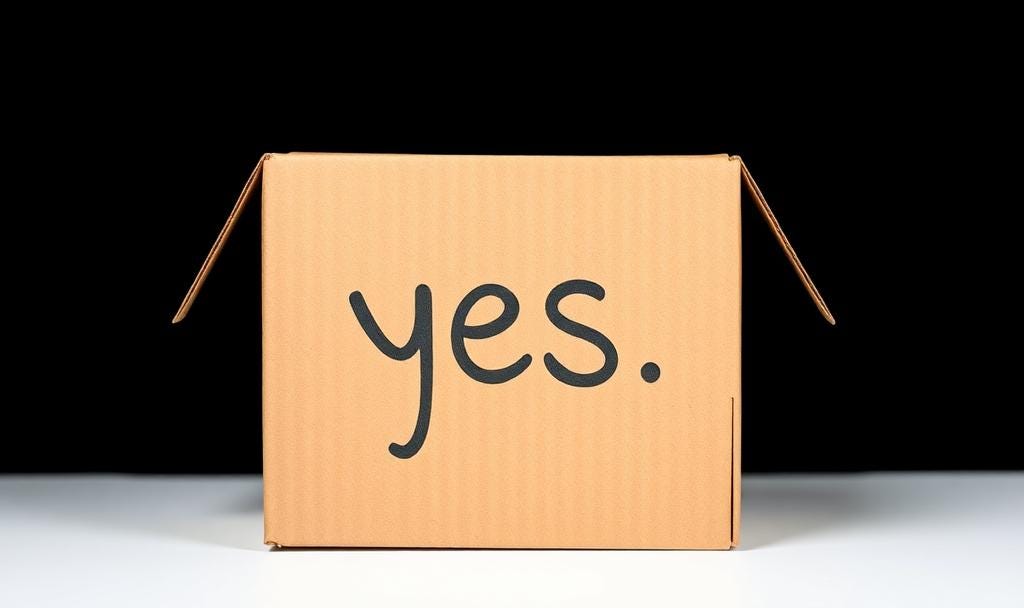
yesbox
Welcome to Swedish Word of the Week #5 — yesbox. I first encountered this little weirdo in the group chat my husband and I have with the parents of the other small kids in our building that our daughter plays with regularly. There are three of them, aged between just-turned-four and five-and-a-half, and, if allowed1, they run freely up and down the stairs and the hallways between each other’s apartments faster than any of us turtle grownups can follow. We therefore call them the Kaos Krew2 (the group chat is called Kaos Krew Kontroll, which is Swenglish for ‘Chaos Crew Control’).
Messages in this chat consist mostly of variations of the following:
var är tjejerna?
(where are the girls?)
dom var precis här men sprang ut.
är dom inte där?
(they were just here but ran out. are they not there?)
nej
(no)
inte här
(not here [either])
jag hör dom på gården nu
(I hear them in the yard now)
At some point in one of these exchanges, someone responded to the inevitable är barnen hos er? (‘are the kids at your place?’) question with “yesbox.”
—at which I poked my head into the kitchen where my husband was doing dishes to ask:
“Uhh…what tf does yesbox mean?”
He laughed for like half a minute and hummed and hawed for longer before telling me that it just meant “yes.”
Me: ……
….but, ‘box’….?
Him: ….yeah, that’s the English word “box.” But the word overall just means ‘yes.’ I honestly have no idea why we say it.
A day or so later he came back with a story about its possible origins in Swedish emigrants in the U.S. back in the day mishearing the phrase ‘yes, boss’— the sort of tale that conjures images of a smudgy-faced Manhattan dock worker in suspenders stubbing out his cigarette and doffing his cap to a beefy foreman who is frowning because he’s tired of these dirty immigrants and wants to get back to harassing women at the garment factory.
According to a local newspaper article from 2013, Swedish folklorist Bengt af Klintberg says that this story is (unsurprisingly) probably apocryphal. (The article also reports the existence of other common, and equally unverifiable, origin stories for yesbox, including it being a reference to the affirmative check-box on an English form and something obscure to do with professional boxing). Klintberg says that the most likely origin is in fact from a once-widespread joke (of the ‘three men walk into a bar’ sort) about a Swedish immigrant to America learning only three English words—‘yes,’ ‘box,’ and ‘alright’—and then repeating them in an unfortunate context that lands him in prison. There are (again, according to the Corren article linked to above) apparently similar joke-stories all over the world about immigrants and language problems3.
Without reading too much into it, I think it’s safe to say that the ubiquity of such joke-stories speaks to something fundamental about the immigrant experience. Us immigrants end up in another part of the world—for love, work, or brute necessity—and find ourselves doing our best to understand and be understood in a foreign language, with consequences that are often as funny as they are difficult (or dangerous). In the case of yesbox, I like that the story seems to have come full-circle: from a time when Swedes were jumping on boats to America in search of a better life, sending back stories of yes-boxes, I have found myself going in the other direction— coming to Sweden in search of (and so far finding) a better life, I have also found my own language spoken back to me, newly incomprehensible, and as necessary for me to understand (where is my kid??) as it is absurd.
Which they usually are, within reason (as dictated by the need to maintain basic discipline, plus the need to ensure our neighbours don’t totally hate us).
I like to imagine that one day the three of them will form a Swedish punk band with this name.
An early one is known from 14th century England, where it refers to—surprise—Welshmen.